Abdal 4iProto Proxy (Multi-Hop)
Abdal 4iProto Proxy is a high-performance, transparent TCP/UDP proxy designed to sit in front of backend services — including Abdal 4iProto Server — and forward traffic safely and efficiently.
It is built specifically for the Abdal 4iProto ecosystem and supports nested Multi-Hop deployments:
Client → Proxy A → Proxy B → Target
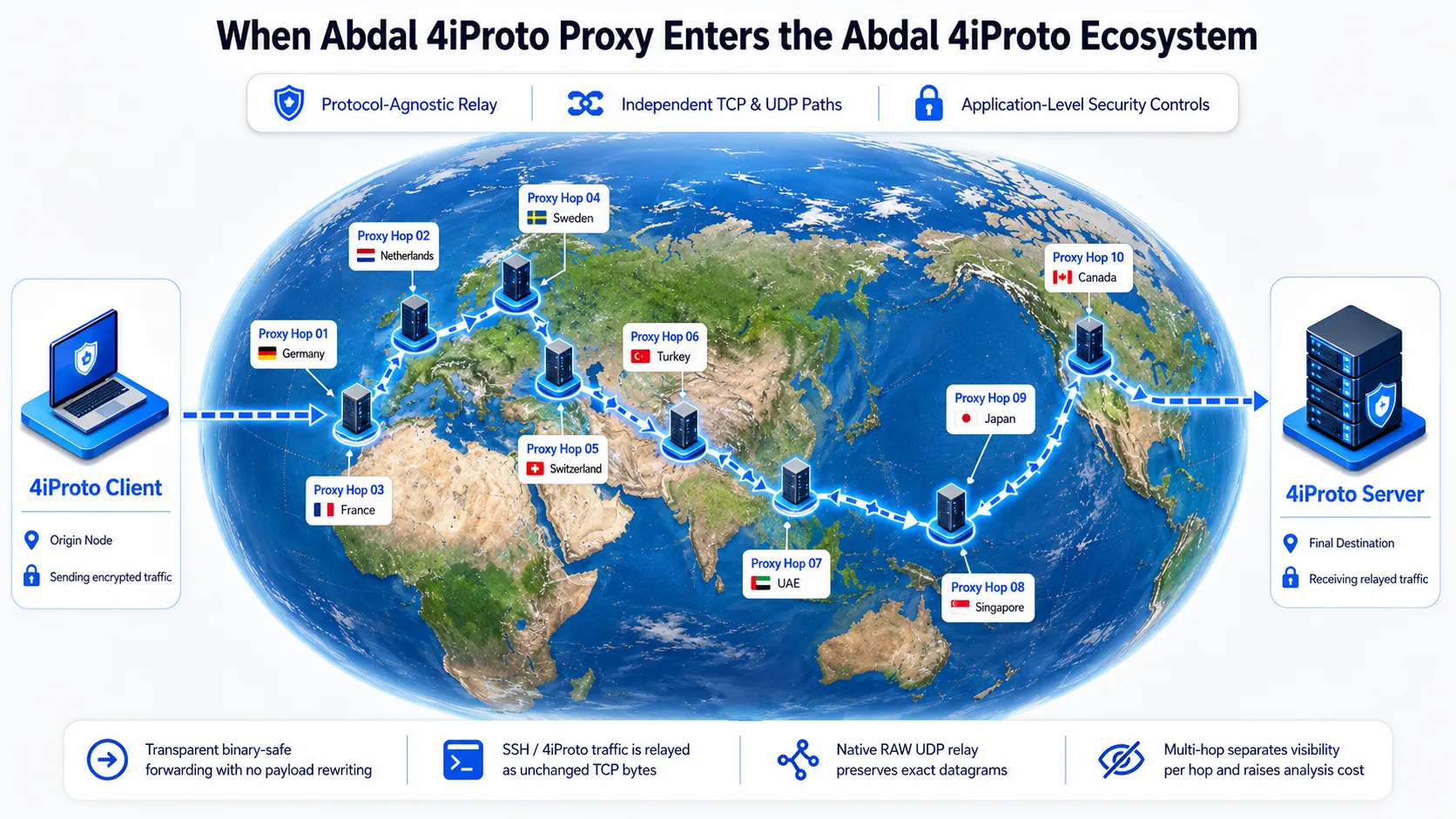
Prefer a dedicated Abdal proxy over manual iptables when you need independent TCP/UDP paths, access control, and Multi-Hop chaining. For classic Linux NAT gateway rules, see Full Traffic Forwarding (iptables).
Why This Software Was Created
Abdal 4iProto Proxy solves a practical networking problem:
- You need a protocol-agnostic relay that does not inspect or rewrite application payloads
- You want independent TCP and UDP forwarding paths
- You need basic security controls (connection limits, IP filtering, flood protection at application level)
- You may chain multiple proxy instances:
Client → Proxy A → Proxy B → Target
For Abdal 4iProto SSH / direct-udpip traffic, this proxy treats the stream as plain TCP bytes and forwards them unchanged. Separately, it also provides a full native RAW UDP relay for applications that send real UDP datagrams.
Part of the Abdal 4iProto Ecosystem
Abdal 4iProto Proxy is designed to work alongside Abdal 4iProto Client/Server as a transparent hop, without becoming an application-layer parser for 4iProto itself.
Ecosystem Benefits
- Hiding the original client IP from the destination — the destination usually sees the IP of the last proxy or the 4iProto server
- Harder traffic attribution — correlating traffic back to the real origin typically requires reconstructing a multi-hop path
- Network separation per hop — each hop only observes its own inbound/outbound relationship
- Content security for 4iProto traffic — when traffic travels inside SSH/4iProto, proxies only relay encrypted payloads
- Higher analysis cost with Multi-Hop — chaining proxies increases the cost of traffic analysis and path reconstruction
Typical ecosystem path:
4iProto Client
      |
      v
Proxy Hop A  --->  Proxy Hop B  --->  Proxy Hop C
      |
      v
4iProto Server / Final Target
Features
Core Proxying
- Independent TCP proxy (
TCP → TCP) - Independent UDP proxy (
UDP → UDP) - Enable/disable TCP and UDP separately via config
- Multi-port listening on both protocols
- Transparent, binary-safe forwarding (no payload rewriting)
- Compatible with chained proxy deployments
TCP Path
- Full-duplex TCP relay
- Idle timeout support
- Protocol-agnostic byte-stream forwarding
- Suitable for SSH / 4iProto TCP tunnels without parsing SSH or
direct-udpip
UDP Path
- Session-based stateful UDP associations (
Client IP + Source Port) - One persistent upstream socket per association (NAT-friendly)
- Multi-response UDP support (
1 request → N responses) - Exact datagram preservation (including zero-length datagrams)
- Large receive buffer (
65535bytes) to reduce truncation risk - Identity-safe session lifecycle
Security
- Max connections per IP
- Max total connections
- Application-level connection flood auto-blacklist
- Static whitelist / blacklist (IP or CIDR)
- Dynamic blacklist with TTL
- Optional loop-prevention checks
Operations
- JSON configuration file
- Colored console logging
- Graceful shutdown
- Windows / Linux service install support
- Cross-platform Go build
How It Works
                     +-> TCP relay -> Target TCP
Client -> Proxy -----|
                     +-> UDP relay -> Target UDP
Path A — Abdal 4iProto over TCP
4iProto Client
      |
      | SSH/TCP (may contain direct-udpip inside)
      v
Abdal 4iProto Proxy
      |
      | unchanged TCP byte stream
      v
Abdal 4iProto Server
The proxy does not parse SSH, does not implement direct-udpip, and does not add/remove framing.
Path B — Native RAW UDP
UDP Application
      |
      | native UDP datagrams
      v
Abdal 4iProto Proxy
      |
      | unchanged UDP datagrams
      v
UDP Target / next proxy hop
Each client endpoint creates one UDP association. Packets are forwarded verbatim. Upstream responses are continuously relayed back to the same client endpoint.
How to Use
Requirements
- Go 1.21+ (for building from source)
- A writable directory for the binary and config file
Build
go build -o abdal-4iproto-proxy .
Configure
Edit abdal-4iproto-proxy.json:
{
  "server_ip": "192.168.10.10",
  "enable_tcp_proxy": true,
  "enable_udp_proxy": true,
  "tcp_ports": [42690],
  "udp_ports": [42690],
  "security": {
    "max_connections_per_ip": 50,
    "max_total_connections": 2000,
    "enable_connection_flood_protection": true,
    "tcp_idle_timeout_seconds": 300,
    "udp_association_timeout_seconds": 60,
    "enable_loop_prevention": true,
    "blacklist_entry_ttl_seconds": 3600
  },
  "access_control": {
    "whitelist": ["10.0.0.0/8"],
    "blacklist": ["1.2.3.4"]
  }
}
Run
./abdal-4iproto-proxy
Or with a custom config path:
./abdal-4iproto-proxy -config /path/to/abdal-4iproto-proxy.json
Service Mode
# Install as system service
./abdal-4iproto-proxy -install-service

# Run as service
./abdal-4iproto-proxy -service

# Uninstall service
./abdal-4iproto-proxy -uninstall-service
Configuration Reference
| Key | Description |
|---|---|
server_ip | Upstream/target server IP or hostname |
enable_tcp_proxy | Independently enable/disable TCP proxy |
enable_udp_proxy | Independently enable/disable UDP proxy |
tcp_ports | Local TCP listen ports to forward |
udp_ports | Local UDP listen ports to forward |
max_connections_per_ip | Per-IP active connection/session limit |
max_total_connections | Global active connection/session limit |
enable_connection_flood_protection | Auto-blacklist IPs that hit per-IP limits |
tcp_idle_timeout_seconds | TCP idle timeout |
udp_association_timeout_seconds | RAW UDP association idle timeout |
enable_loop_prevention | Detect obvious localhost proxy loops |
blacklist_entry_ttl_seconds | Dynamic blacklist lifetime |
access_control.whitelist | Always-allowed IPs/CIDRs |
access_control.blacklist | Always-blocked IPs/CIDRs |
Useful Examples
- TCP only:
"enable_tcp_proxy": true,"enable_udp_proxy": false - UDP only:
"enable_tcp_proxy": false,"enable_udp_proxy": true - Both: keep both flags
true
udp_association_timeout_seconds belongs to this proxy’s RAW UDP associations. It is not the Abdal 4iProto Server SSH direct-udpip idle timeout.